
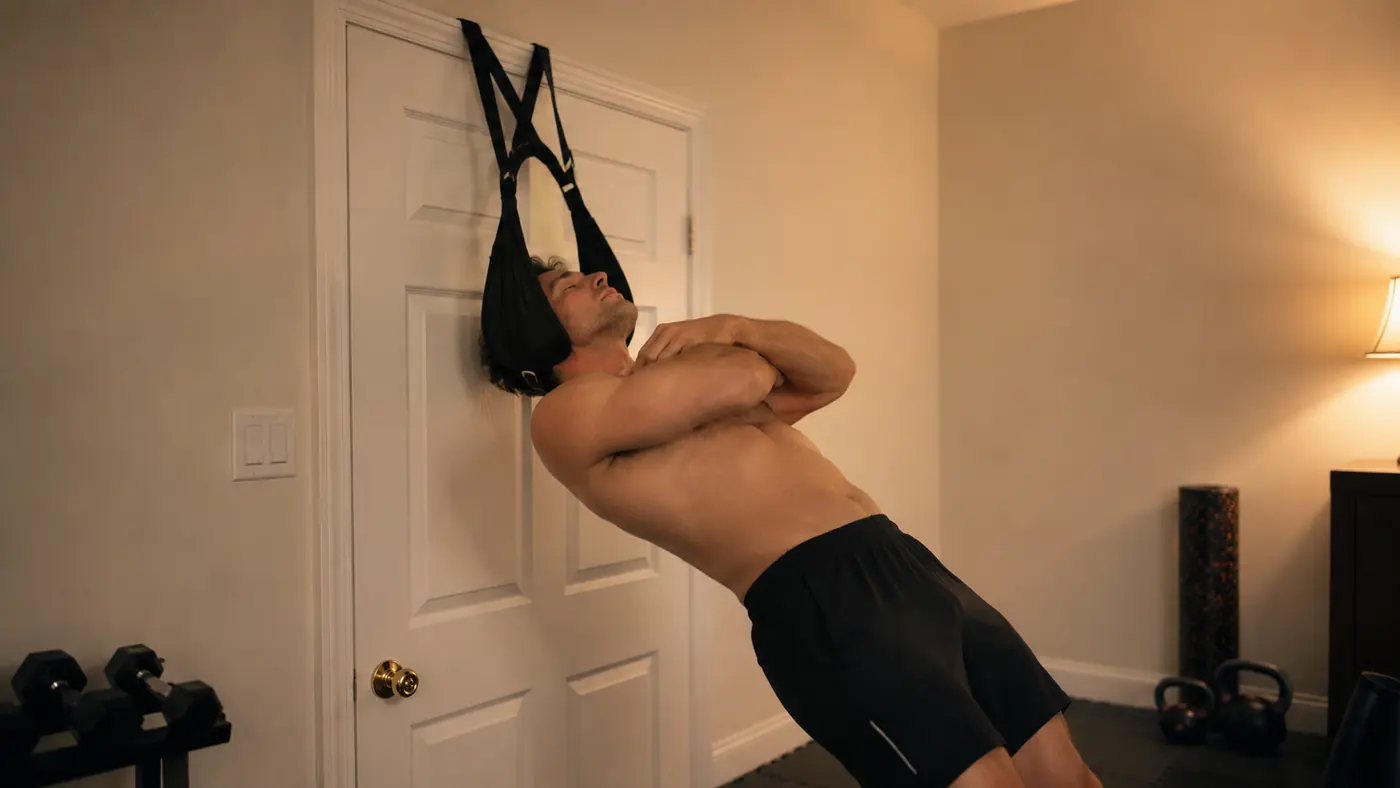
The first time I hung The Original Neck Hammock over my spare bedroom door, I did it wrong. I looped the strap over the hinge side instead of centered on the flat top edge, leaned back, and felt one side of my jaw take almost all the pressure while the other side did nothing. That is not a design flaw. That is a setup mistake, made by a licensed sports-massage therapist who explains proper alignment to clients four days a week. I am telling you that story first because most neck hammock reviews skip straight to how relaxing it feels once everything is dialed in, and skip the part where you are standing in a doorway at seven at night trying to figure out which way the strap is supposed to hang.
I bought this one for the same reason a lot of my clients would want it. My neck and upper traps are chronically tight from leaning over a massage table for a living, the same forward-head pattern my clients call tech neck. I get it from the table, you probably get it from a screen, the tissue does not care where the posture came from. I have hung this off my spare bedroom door most evenings for weeks now, right after I finish client notes on my laptop at the kitchen counter, and this review is the honest version. The setup, the strap comfort problem, and whether the relief actually holds once you unhook and stand back up.
The Quick Verdict
A genuinely useful five to ten minute reset for a tight neck once you get the door setup right, but the ear and jaw pressure takes real practice to tolerate and the relief fades faster than I wanted it to.
Amazon Check Today's Price →Before You Hang This on a Door, Read the Setup Mistake I Made First
The Original Neck Hammock works, but the door you pick and the way you loop the strap change everything about how it feels. Check today's price and current rating on Amazon.
Amazon Check Today's Price on Amazon →How I've Used It
My routine settled into something predictable after the first shaky week. Most evenings, after I have finished typing up client notes at the kitchen counter, I go back to the spare bedroom, loop the strap over the top of the door, and lie back with the fabric under my jaw and the base of my skull for somewhere between five and ten minutes. I keep the incline shallow at first, just a slight recline with my feet still under me, and only lean back further once my neck feels warmed up. I do this four or five nights a week, not every single night, because there are evenings my neck genuinely does not need it and I would rather save the habit for when it does.
I did not start with the manufacturer's full recommended hang time. My first few sessions were closer to two minutes, because ten minutes of traction on tissue that has been guarding for years is not something I wanted to push into on day one. I built up gradually over about ten days, adding a minute or two at a time and paying attention to how my neck felt the next morning rather than how relaxed I felt in the moment, since those two things do not always agree.
The place matters more than I expected going in. My spare bedroom door is solid, it does not rattle in the frame, and there is enough clear floor space on the far side for me to lean back without my hips bumping the doorframe. That sounds like a small detail. It is not. I will get into exactly why in the next section, because the door itself ended up being the single biggest variable in whether a session felt calm or felt like a fight with my own equipment.
The Door Problem Nobody Mentions
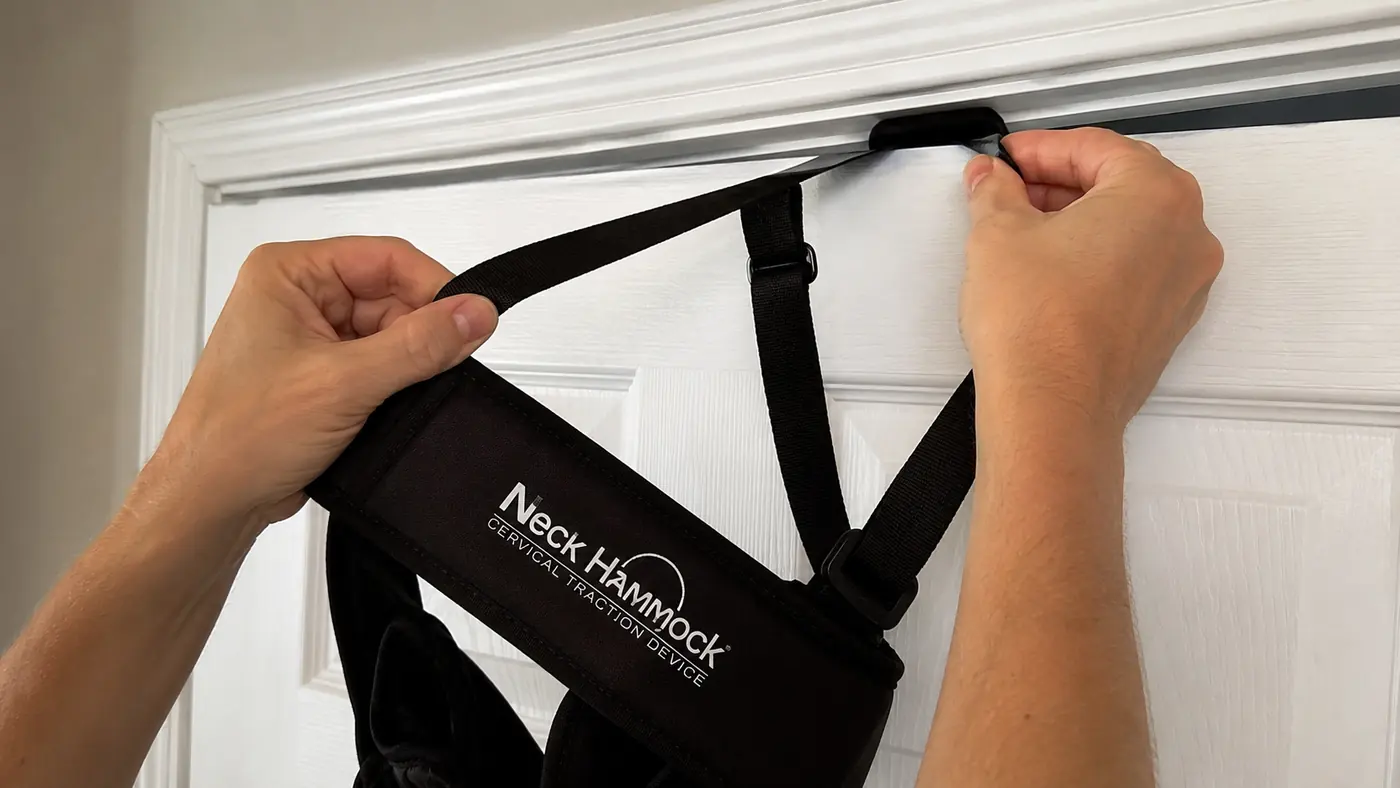
Nearly every photo of this product shows it hanging cleanly over a plain, solid interior door with room to spare. What nobody tells you is how many common doors do not work well with it. My spare bedroom door is a standard solid-core swing door, and even that took a few tries to get the strap centered and flat. Hollow-core doors, the light, cheap ones a lot of apartments and older houses use for bedrooms and closets, tend to flex more under the tension, and I would be cautious hanging real body weight off the top edge of one repeatedly.
Doors with any kind of decorative molding along the top edge are a real problem, because the strap wants a flat surface to sit on and a raised trim piece pushes it forward or lets it slide. I tried it briefly on a door with a slightly rounded top edge and the strap kept creeping toward the hinge side no matter how carefully I centered it, which is exactly the uneven-jaw-pressure problem I described at the start. Sliding barn doors and folding closet doors are out entirely, there is nothing solid at the top to anchor against. And you need real clearance on the far side, at minimum enough space to lean back fully without your heels or hips hitting a wall, dresser, or the doorframe itself, which ruled out two of the three interior doors in my own house before I settled on the spare bedroom.
None of this is in the product photos, and I understand why, a doorway with a bed six inches behind it does not photograph as relaxing. But if you are picturing this working on any door in your house, spend two minutes actually testing the fit and the clearance before you commit to a routine around it. I wasted the better part of a week bouncing between two doors that technically worked but never felt fully stable, and that instability alone was enough to keep me tense instead of letting my neck actually release.
The Strap Comfort Problem, and What Actually Helped
This is the part I was least prepared for. The fabric strap sits under your jaw and the base of your skull, and the pressure is concentrated in a fairly narrow band right along the jawline and behind the ears. For the first several sessions, that pressure was genuinely uncomfortable, not painful exactly, but distracting enough that I could not relax into it the way the marketing photos suggest you will. My jaw muscles, which clench more than I would like from years of the same posture that gives me tech neck in the first place, tensed up against the strap instead of letting go.
What helped was almost entirely about positioning, not toughing it out. Centering my head so the strap sat more under the base of my skull than directly under my jaw shifted the pressure to a spot my body tolerated much better. Keeping my jaw slightly open rather than clenched shut made a noticeable difference too, that is a cue I give clients on the table constantly and I had to remind myself of it here. I also found that a folded hand towel between the strap and one side of my jaw, on the days that side felt more sensitive, took the edge off without changing the traction angle much.
By the third week, the discomfort had mostly resolved into something I would call neutral pressure rather than actual relief-inducing sensation for the first thirty seconds or so, then it did ease into something closer to relaxing. I want to be straightforward that this took real repetition to get comfortable with. If your first session feels like your jaw is the main thing under load rather than your neck, that is common, not a sign you are using it wrong, and it is worth adjusting the head position before deciding the product itself is the problem.
Whether the Relief Actually Lasts
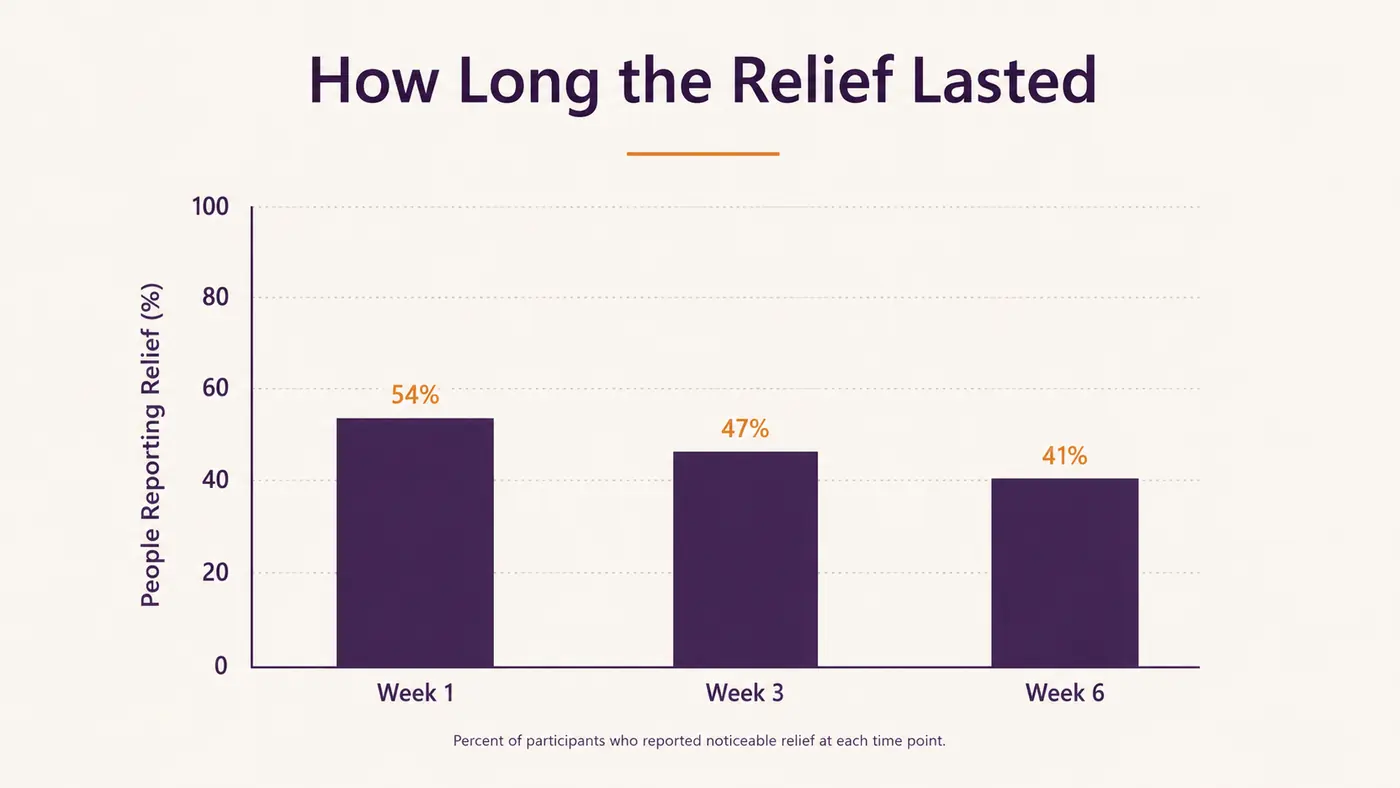
In the moment, almost every session gave me something. My upper traps loosened, the tightness at the base of my skull eased, and I could usually feel my shoulders drop a little as the ten minutes went on. The honest question is what happened after I unhooked the strap and went back to typing notes or lying down for the night, and the answer is more modest than I wanted it to be. In the first couple of weeks, that looser feeling lasted maybe twenty to forty minutes before the familiar tightness started creeping back in, especially on days I had spent hours leaning over a table.
By week four or five, the sessions were still giving me that same in-the-moment ease, but the carryover got a bit longer, closer to an hour or two on a good day, and mornings after a session the night before felt noticeably less stiff than mornings I skipped it. That is a real change, but it is a small, incremental one built on consistency, not a single session that reset my neck for good. I tracked it loosely rather than scientifically, mostly just noting whether my neck felt tight or loose when I woke up, and the trend moved in the right direction slowly rather than dramatically.
The Honest Caution About Traction Near Your Neck
I want to be direct about this part because I would say the same thing to a client. This device applies real traction to your cervical spine, not a passive stretch you can just power through. Start with the shortest hang time and the shallowest incline you can, add time gradually, and stop immediately if you feel numbness, tingling, sharp pain, or dizziness rather than a general loosening sensation. If you have a diagnosed disc issue, a history of neck surgery, or any condition affecting your cervical spine, I would talk to your doctor or physical therapist before using this at all, and I am not the person to tell you whether it is appropriate for your specific situation.
I am also not going to pretend this replaces actual manual therapy for anyone dealing with a real cervical issue rather than ordinary daily tightness. In the treatment room I see the difference between garden-variety tech neck tension and something that needs an actual assessment, and a door-anchored traction device is a reasonable tool for the first category, and not a substitute for the second. If your neck pain came on suddenly, radiates down an arm, or has not improved after a few weeks of consistent use, that is a sign to get it looked at properly rather than adding more hang time and hoping.
What I Liked
- Genuinely eases upper trap and base-of-skull tightness within a five to ten minute session
- Compact enough to fold and tuck in a drawer between uses
- Adjustable strap length works with more than one door once you find the right one
- Carryover relief did lengthen with several weeks of consistent use
- Cheap enough to try against a real evening routine
Where It Falls Short
- Jaw and ear strap pressure is genuinely uncomfortable for the first several sessions
- Not every door in a typical house is stable enough or has enough clearance to use it well
- In-the-moment relief faded within an hour or two for most of the first month
- Requires real traction discipline, this is not something to rush or overdo
The relief was real, it just was not automatic, and it was not permanent. It was a five to ten minute reset I had to earn a door and a strap position at a time.

Who This Is For
This suits someone with ordinary forward-head tightness, whether that comes from a screen, a steering wheel, or in my case a massage table, who has a stable solid door with real clearance behind it and is willing to spend the first week or two adjusting head position instead of expecting instant comfort. It is a good fit if you already have some kind of consistent evening wind-down and want a specific tool for the neck and upper traps rather than general relaxation. For a fuller list of exactly what it helps with, I laid out ten specific reasons it eases tech neck in more detail, and I also tracked a longer daily-use log in my long-term neck hammock review if you want the week-by-week version of this same product.
Who Should Skip It
If you do not have a door that fits the setup requirements I described, do not force it onto a hollow-core door or one without real clearance behind it, that is not worth the instability. Skip it, or get medical clearance first, if you have any diagnosed cervical spine condition, a history of neck surgery, or nerve symptoms like numbness or tingling down an arm. And if jaw tension is already a significant issue for you on its own, the strap pressure may be more frustrating than useful until that is addressed separately. I would rather you skip this than push through discomfort that is telling you something. For the full step-by-step on using it safely once you do decide it is right for you, I wrote a complete setup and session guide that goes through the incline and timing progression in order.
Once the Door and the Strap Are Dialed In, It Earns Its Spot in the Evening
The setup takes patience, but a stable door and a few sessions of practice turned this into a real part of my wind-down routine. Check today's price and current rating on Amazon.
Amazon Check Today's Price on Amazon →